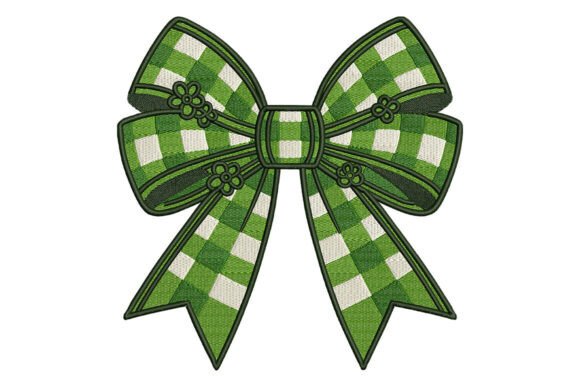
Green Gingham Bow Embroidery
A Practical Review for Small Business Merch & Branded Patches
As an embroidery designer who’s digitized and stitched thousands of designs for cafés, boutiques, florists, bakeries, and handmade studios, I approach every new machine embroidery design with two questions: “Does it translate into real-world brand value?” and “Will it hold up across diverse applications — from staff aprons to customer tote bags?” That’s why Green Gingham Bow Embroidery caught my attention. At first glance, its title and description promise a balance — playful yet elegant, detailed yet bold. But in business embroidery, first impressions must survive washing, wear, and repeated production runs. Let’s break down how Green Gingham Bow Embroidery performs where it counts.
First Impression: Friendly, Handmade, and Timelessly Approachable
The phrase “green gingham bow with delicate stitched flowers” immediately signals warmth and intentionality — not mass-produced, but thoughtfully crafted. Green evokes freshness (ideal for florists, organic bakeries, or pet wellness brands), while gingham suggests rustic charm and small-batch authenticity. The “bold outline” is a smart design cue: it ensures legibility at smaller scales and gives structure to the soft floral details. For small business owners building handmade product credibility, this design feels like a natural extension of that ethos — neither overly formal nor too whimsical. It lands firmly in the Fashion Beauty category not because it’s glamorous, but because it elevates everyday items with quiet confidence.
Where Green Gingham Bow Embroidery Shines in Business Use
- Embroidered patches: Its balanced proportions and clear silhouette make Green Gingham Bow Embroidery ideal for iron-on or sew-on patches — especially on denim jackets, canvas tote bags, or boutique packaging. The gingham grid reads cleanly even at 2.5” width.
- Staff uniforms & aprons: As a chest accent or sleeve detail, it adds personality without overwhelming function. Cafés and florists report higher customer engagement when staff wear subtle, cohesive branding like this — it feels personal, not corporate.
- Cap embroidery: On structured front panels (6-panel caps, trucker hats), the bold outline prevents fill distortion. Avoid low-profile curved crowns unless resized and re-digitized — more on that below.
- Tote bag design & product labels: When stitched onto natural cotton or linen totes, the green thread pops against neutral backgrounds. Paired with minimalist typography, it becomes a signature mark — think “The Wild Fern Bakery” or “Petal & Paw Studio.”
- Etsy branding & craft business assets: As a consistent visual anchor across listings, packaging, and social mockups, Green Gingham Bow Embroidery strengthens brand identity without requiring custom illustration. It’s instantly recognizable, scalable, and emotionally resonant.
Use With Care: Real-World Limitations to Anticipate
Even strong designs have boundaries — and respecting them protects your reputation and your client’s investment. Here’s where Green Gingham Bow Embroidery needs thoughtful handling:
- Small patch sizes under 1.75”: The “delicate stitched flowers” and “detailed checkered pattern” risk fill-in or loss of definition. Always request or run a test stitch-out at your target size before bulk production.
- Curved surfaces (like cap crowns or curved tote handles): The bold outline helps, but dense fill areas may pucker. Consider simplifying flower stems or reducing stitch density if adapting for high-curve zones.
- Dark or textured fabric: On charcoal uniforms or heavy twill, contrast matters. Verify thread colors — emerald or sage greens often outperform neon or yellow-based greens on dark backgrounds.
- Frequent washing: While gingham patterns hold up well, tightly packed stitches near flower centers can abrade over time. Recommend tear-away + cut-away stabilizer combo for longevity on aprons and work shirts.
How It Builds Brand Trust and Customer Connection
In small business merch, consistency isn’t just visual — it’s emotional. Green Gingham Bow Embroidery supports brand identity by offering instant recognition without shouting. Customers remember how something *feels*: soft but intentional, cheerful but refined. That duality builds trust — especially for service-based or artisanal businesses where authenticity is currency. When a bakery uses it on staff aprons *and* customer gift totes, the repetition reinforces reliability. When an Etsy seller pairs it with a printable mockup and cohesive packaging, it elevates perceived product value. This isn’t decoration; it’s silent storytelling.
Practical Designer Notes Before You Stitch
- Test the digital embroidery file in black and white first — assess balance, spacing, and edge clarity without color distraction.
- Verify performance at your smallest intended size (e.g., 1.5” wide for cap fronts) — does the gingham grid remain legible? Do flower outlines stay distinct?
- Review thread color contrast on your target fabric — especially for commercial embroidery jobs where clients expect color accuracy.
- Inspect spacing between bow loops and flower elements — tight gaps may cause nesting or thread breaks on older machines.
- Confirm hoop size compatibility and whether the design fits within standard commercial hoops (e.g., 4x4”, 5x7”) without re-hooping mid-stitch.
- Always test on actual fabric — not just stabilizer — to evaluate tension, puckering, and texture interaction.
- Create a physical or digital mockup for client approval *before* digitizing adjustments or starting production.
- Compare Green Gingham Bow Embroidery beside your other design assets — does it harmonize with your logo, fonts, and existing merch?
- Confirm commercial licensing applies — especially if selling finished products (e.g., embroidered totes on Etsy) or offering as part of a branded package.
Ultimately, Green Gingham Bow Embroidery succeeds not because it’s technically complex, but because it serves a purpose: helping small businesses express warmth, craftsmanship, and distinction — one precise stitch at a time. Whether you’re a solo embroiderer, a boutique apparel decorator, or a maker launching your first line of custom apparel, this design earns its place in your embroidery library — provided you treat it with the same care you’d give your own brand.