Purple Iris: A Small Business Embroidery Review
First Impression: Charming, Quirky, and Surprisingly Versatile
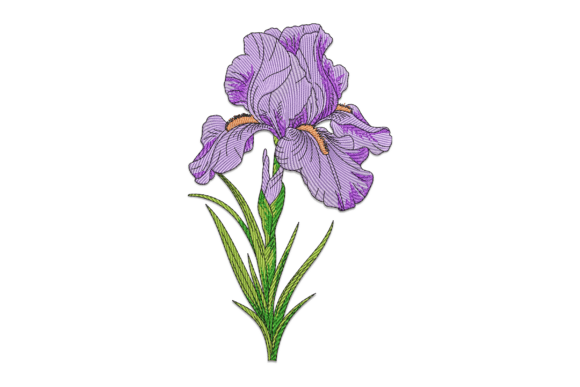
As an embroidery designer who’s developed hundreds of commercial designs for cafés, boutiques, florists, and handmade brands, my first read on Purple Iris lands right where the description promises: “charming” and “fun and quirky.” It doesn’t scream corporate or ultra-minimalist—but that’s precisely its strength for small business merch. In the Single Flowers Plants category, Purple Iris stands out not for botanical precision, but for expressive personality. It reads as friendly yet refined—elegant enough for a local florist’s apron, playful enough for a pet brand’s tote bag design, and distinctive enough to anchor a boutique’s custom apparel line.
Real-World Performance Across Business Touchpoints
Purple Iris shines where authenticity matters most: in tangible, tactile brand moments. As an embroidered patch, it holds up beautifully when sewn onto denim jackets, canvas totes, or staff uniforms—its organic shape avoids the stiffness that plagues over-digitized florals. On café aprons or bakery smocks, it adds warmth without clutter; the “quirky flair” translates into approachability, helping customers subconsciously associate your space with care and craft.
For cap embroidery, Purple Iris works best on structured front panels (not curved low-profile caps) where its gentle curves read clearly at 2.5–3 inches wide. Paired with subtle thread colors—like heathered lavender on charcoal twill—it reads as intentional, not cutesy. On tote bags and reusable shopping sacks, it scales well as a centered chest logo or sleeve accent, especially when balanced with clean typography or a simple monogram.
In product packaging accents—think stitched labels on handmade soap wraps or linen tea towel hems—Purple Iris elevates perceived value. Unlike generic florals, it feels curated. That’s critical for Etsy sellers and craft businesses: buyers pay more for items that signal thoughtful design, not mass production. As part of a broader set of design assets, it pairs seamlessly with hand-drawn fonts or watercolor-inspired mockups—making printable mockups feel cohesive and brand-aligned.
Where to Use Purple Iris Thoughtfully
Like any strong machine embroidery design, Purple Iris has boundaries—and respecting them protects your brand reputation. Avoid shrinking it below 1.75 inches for patches: delicate petal outlines risk bleeding or disappearing on dense fabrics like duck canvas or thick terry cloth. On curved surfaces—especially cap fronts under 2 inches—test stitch density carefully. High-density fills may pucker; opt for satin-stitched petals with open negative space to maintain breathability.
Dark uniforms? Yes—but only with high-contrast thread colors. A deep violet iris on navy fabric needs either bright white or pale gold thread to avoid visual washout. Always test on your exact fabric texture: Purple Iris’s charm relies on crisp edge definition, which can blur on highly napped fleece or loosely woven linen unless stabilized properly.
Frequent washing is another real-world factor. If embroidering staff work shirts or kitchen towels, confirm the embroidery file uses secure underlay and lock stitches—not just decorative top layers. This isn’t stated in the description, so verify before bulk production. Likewise, check whether the design includes multiple color-separation options; flexibility here saves time when matching brand palettes across merchandise lines.
How Purple Iris Shapes Brand Identity and Customer Trust
Small businesses don’t just sell products—they sell feeling. Purple Iris supports that by projecting consistency without rigidity. It’s recognizable across contexts: embroidered on a barista’s sleeve, stitched into a customer gift bag, or scaled down as a label on artisan chocolate packaging. That repetition builds familiarity—the foundation of trust.
Unlike clip-art florals, Purple Iris feels human-made. Its slight asymmetry and soft contours suggest craftsmanship, aligning perfectly with handmade product positioning. For creative studios or local makers, that nuance tells customers: *We chose this detail intentionally. We care about how things look and feel.* That perception directly lifts perceived product value and encourages repeat engagement.
Visually, it also offers breathing room—no aggressive angles or sharp vectors competing with your logo. When used alongside other design assets, it complements rather than competes, supporting visual hierarchy instead of undermining it.
Practical Designer Notes Before You Stitch
- Always test in black and white first—this reveals contrast issues and hidden density traps before thread selection.
- Check minimum viable size for your intended use: does Purple Iris retain clarity at 1.5" for iron-on patches? At 2" for cap fronts?
- Review thread color contrast on your target fabric swatch—not just on screen. What looks vibrant digitally may mute on textured cotton.
- Inspect spacing between elements: are petal tips too close to stem lines? Tight gaps increase risk of skipped stitches on commercial machines.
- Confirm hoop size compatibility—if you’re running high-volume jobs, ensure Purple Iris fits your standard hoops without re-hooping mid-run.
- Test on real fabric with proper stabilizer: lightweight tear-away for towels, cut-away for stretch knits, and medium-weight fusible for aprons.
- Create a client-facing mockup before final approval—especially for uniform or retail merch projects.
- Compare beside existing assets: does Purple Iris harmonize with your current logo, typography, and color system—or clash subtly?
- Verify commercial licensing before using on paid merchandise. Since this is a digital embroidery file marketed for business use, confirm permissions cover resale, branding, and multi-location deployment.
Final Thought: More Than a Flower—A Brand Signature
Purple Iris isn’t just another Embroidery file. It’s a quiet brand amplifier—ideal for small businesses that want to stand out through sincerity, not scale. Whether you’re stitching it onto a florist’s delivery tote or a ceramic studio’s limited-edition apron line, it carries weight because it feels chosen, not dropped in. For embroidery shops and apparel decorators, it’s a reliable, conversation-starting asset—one that delivers both aesthetic appeal and strategic brand reinforcement. Just remember: great commercial embroidery starts with intention, testing, and respect for the fabric—and Purple Iris, when used wisely, honors all three.